
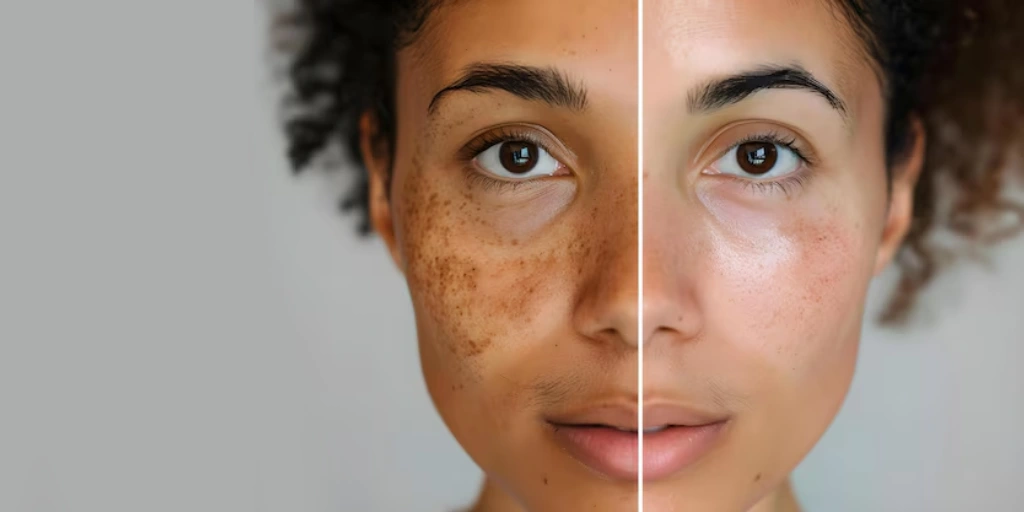
Dark spots or patches on the skin can indicate a range of underlying issues, and proper treatment hinges on a precise diagnosis.
understanding the difference between melasma and general hyperpigmentation is key, and this distinction is important for your skin health.
Skin pigmentation concerns are among the most common reasons patients visit a dermatologist — particularly in India, where higher melanin levels and year-round sun exposure create the perfect conditions for both melasma and other forms of hyperpigmentation to develop.
But here is what many people get wrong: not all dark patches are the same. Treating melasma like ordinary sun damage — or vice versa — can lead to months of wasted effort, or worse, skin irritation that makes the problem significantly harder to resolve.
In this, we break down the clinical difference between melasma and hyperpigmentation, how each condition is diagnosed, and what treatment options are available at a specialist dermatology clinic in Noida.
Understanding Hyperpigmentation: The Fundamentals
Hyperpigmentation is a catch-all phrase. It describes any situation where areas of skin are darker than their surroundings, a result of an overabundance of melanin.
Melanin, the pigment responsible for skin colour, is produced by melanocytes. When these pigment-producing cells go into overdrive, they leave behind a concentrated deposit of melanin, resulting in a visible dark spot.
Common types of hyperpigmentation include:
- Post-inflammatory hyperpigmentation (PIH) — dark marks left behind after acne, eczema, or skin injury
- Sunspots (solar lentigines) — flat, brown spots caused by cumulative UV exposure
- Freckles (ephelides) — genetically driven, sun-activated small pigmented spots
- Drug-induced hyperpigmentation — triggered by certain antibiotics, antimalarials, or chemotherapy agents
- Melasma — a specific, hormonally influenced subset of hyperpigmentation (discussed separately below)
Hyperpigmentation is generally an epidermal condition, meaning the excess pigment sits in the outermost layers of the skin. This makes many forms of general hyperpigmentation more responsive to standard topical treatments and chemical peels.
Why Accurate Diagnosis Matters
Not every dark patch needs the same treatment. A correct diagnosis from a qualified dermatologist is the single most crucial step in clearing any form of skin pigmentation.
What Is Melasma? A Closer Clinical Look
Melasma is a specific, chronic form of hyperpigmentation characterised by symmetrical, irregularly shaped brown or grey-brown patches — most commonly appearing on the cheeks, forehead, upper lip, nose bridge, and chin. It is far more prevalent in women, particularly those of reproductive age (20 to 45 years), and is significantly more common in individuals with Fitzpatrick skin types III to V — which includes most South Asian patients.
What Causes Melasma?
Melasma is driven by a combination of three factors, all of which must be managed together for treatment to succeed:
- Hormonal influence — oestrogen and progesterone stimulate melanocytes. This is why melasma is strongly associated with pregnancy (the ‘mask of pregnancy’), oral contraceptive use, and hormone replacement therapy.
- UV exposure — ultraviolet radiation is the primary trigger that activates melanocyte overproduction. Even brief, daily UV exposure can maintain or worsen melasma.
- Genetic predisposition — a family history of melasma significantly increases risk.Patients of South Asian, Latin American, and Middle Eastern descent are disproportionately affected.
How Deep Does Melasma Go?
This is a critical clinical distinction. Melasma can occur in three patterns based on depth:
- Epidermal melasma — pigment in the upper skin layers; responds well to topical agents and light-based treatments
- Dermal melasma — pigment in the deeper dermis; more resistant to treatment and prone to relapse
- Mixed melasma — the most common type in Indian patients; requires a layered, combination treatment approach
A Wood’s lamp examination and, in some cases, a reflectance confocal microscopy assessment, can help your dermatologist determine the depth of pigmentation and plan the most effective treatment protocol.
Melasma vs. Hyperpigmentation: Side-by-Side Comparison
Use this table to understand the key clinical differences between melasma and general hyperpigmentation:
| Feature | Melasma | General Hyperpigmentation |
| Definition | Hormonal pigmentation disorder | Hormonal pigmentation disorder |
| Location | Face — cheeks, forehead, upper lip | Anywhere on the body |
| Main Trigger | Hormones + UV exposure | UV rays, inflammation, injury |
| Who Is Affected | Women (especially 20–45 years) | All genders, all ages |
| Depth | Epidermal, dermal, or mixed | Typically epidermal |
| Pattern | Symmetrical, map-like patches | Spots, patches — variable shape |
| Recurrence | Very high without maintenance | Depends on trigger control |
| Treatment Complexity | High — requires layered approach | Moderate — responds to standard care |
Clinical Note
Melasma is the most challenging form of hyperpigmentation to treat — not because treatments do not work, but because it almost always recurs without ongoing sun protection and maintenance therapy.
How Is the Correct Diagnosis Made?
At a qualified dermatology clinic, diagnosis involves more than a visual inspection. Your dermatologist will:
- Review your full medical and hormonal history — including contraceptive use, pregnancy, and medications
- Examine the pattern, distribution, and border characteristics of the pigmentation
- Use a Wood’s lamp to assess pigmentation depth (epidermal vs.dermal)
- Rule out other pigmentary disorders such as lichen planus pigmentosus, exogenous ochronosis, or Riehl’s melanosis, which can mimic melasma
This diagnostic rigour is essential because applying incorrect treatments — particularly aggressive bleaching agents or certain laser settings — to the wrong type of pigmentation can trigger post-inflammatory hyperpigmentation, worsening the very problem you are trying to resolve.
Treatment Options: What Works — and What Does Not
Treating General Hyperpigmentation
For most forms of hyperpigmentation (sunspots, PIH, freckles), a consistent treatment plan including the following will yield good results:
- Broad-spectrum SPF 50+ sunscreen — daily application is non-negotiable
- Topical depigmenting agents — Vitamin C, niacinamide, kojic acid, alpha arbutin, or azelaic acid
- Chemical peels — glycolic acid or lactic acid peels to accelerate epidermal turnover
- Laser toning sessions — Q-switched Nd:YAG or picosecond lasers for resistant lesions
Treating Melasma: Why It Requires a Different Approach
Melasma demands a more carefully calibrated and patient-centred strategy. Because it is hormonally driven and prone to relapse, the goal is not just clearance but long-term control. Effective melasma management typically involves:
- Strict photoprotection — physical sunscreens with SPF 50+ PA++++, worn every single day, regardless of season or indoor activity. UV from screens and indoor lighting can still trigger melasma.
- Prescription topical therapy — modified Kligman’s formula (hydroquinone + tretinoin + mild steroid) remains the gold standard, used in supervised, intermittent cycles to prevent side effects
- Tranexamic acid — available in both oral and topical formulations, particularly effective for Indian patients with mixed-type melasma
- Chemical peels — superficial to medium-depth peels using mandelic acid, glycolic acid, or yellow peel combinations
- Laser and light-based treatments — low-fluence Q-switched Nd:YAG laser toning or picosecond technology; these must be performed at conservative settings in Indian skin to avoid rebound hyperpigmentation
- Hormonal management — in consultation with a gynaecologist, switching contraceptive methods may be advised where hormonal triggers are identified
At Arcane Skin & Hair clinic Noida
At our clinic in Noida, we offer a dedicated Melasma Management Programme that combines dermatologist-prescribed topicals, supervised peels, and laser toning — all customised to your skin type and lifestyle.
Common Mistakes Patients Make whether dealing with melasma or another form of hyperpigmentation, these are the most frequent errors that delay results:
- Skipping sunscreen on cloudy days or indoors — UV penetrates glass and clouds. Consistent SPF use is the foundation of any pigmentation treatment.
- Using skin-lightening products bought online without a dermatologist’s guidance — unsupervised use of hydroquinone or mercury-containing agents can cause paradoxical darkening or systemic toxicity.
- Expecting overnight results — melasma in particular is a months-long management process, not a quick fix.
- Stopping treatment the moment skin improves — without maintenance therapy, melasma recurs in the vast majority of patients.
- Self-treating with high-intensity at-home devices — improper laser or IPL use at home can cause burns, scarring, or severe PIH in darker skin tones.
When Should You See a Dermatologist in Noida?
You should book a consultation with a qualified dermatologist if:
- Dark patches on your face have persisted for more than 8 to 12 weeks despite using standard skincare products
- Pigmentation appeared or worsened during or after pregnancy, or after starting hormonal contraception
- You have tried multiple over-the-counter products without visible improvement
- You are unsure whether your pigmentation is melasma, PIH, or another condition
- You want to explore professional-grade treatments such as chemical peels or laser toning
Early, accurate diagnosis means faster results and a lower risk of complications.The longer a pigmentation condition goes untreated or is treated incorrectly, the more entrenched it becomes — particularly in the case of dermal melasma. 📞 Book Your Skin
Pigmentation Consultation in Noida — Speak to a Dermatologist Today.
Our skin specialists provide personalised melasma and pigmentation assessments for every skin type. Early intervention leads to improved results.
Frequently Asked Questions.
Is melasma the same as hyperpigmentation?
Melasma, a specific type of hyperpigmentation, is distinct from other forms of hyperpigmentation.The crucial difference lies in its hormonal origins, its symmetrical facial presentation, and its propensity to return.Other forms of hyperpigmentation — such as sunspots or PIH — have different triggers and often respond more readily to treatment.
Can melasma be permanently cured?
Melasma is a chronic condition that can be effectively controlled and significantly lightened, but because the underlying hormonal sensitivity of melanocytes remains, it has a strong tendency to recur — especially with sun exposure.Most dermatologists approach melasma as a long-term management condition rather than a one-time cure.
Is laser treatment safe for melasma on Indian skin?
Yes, but it must be performed by an experienced dermatologist using the correct settings for darker Fitzpatrick skin types. Aggressive laser settings can cause post-inflammatory hyperpigmentation in Indian skin. Low-fluence Q-switched Nd:YAG laser toning and picosecond lasers are currently considered among the safer options when used conservatively alongside topical therapy. At arcane, we have Noida’s best laser treatments available.
What SPF should I use for melasma?
Dermatologists recommend a broad-spectrum sunscreen with minimum SPF 50 and PA++++, applied generously every day — including on cloudy days and indoors. Physical or mineral sunscreens (containing zinc oxide or titanium dioxide) are particularly recommended for melasma-prone skin as they provide more complete protection against both UVA and UVB radiation.
How long does melasma treatment take to show results?
Most patients begin to see visible lightening within 8 to 12 weeks of starting a consistent treatment plan. However, significant improvement — particularly for mixed or dermal melasma — typically requires four to six months of dedicated therapy. Maintenance is ongoing.